
And how does this compare to hiring a part time permanent employee?
You need help in your business. The admin is piling up, the inbox is winning, and you’ve started wondering whether it’s time to take someone on.
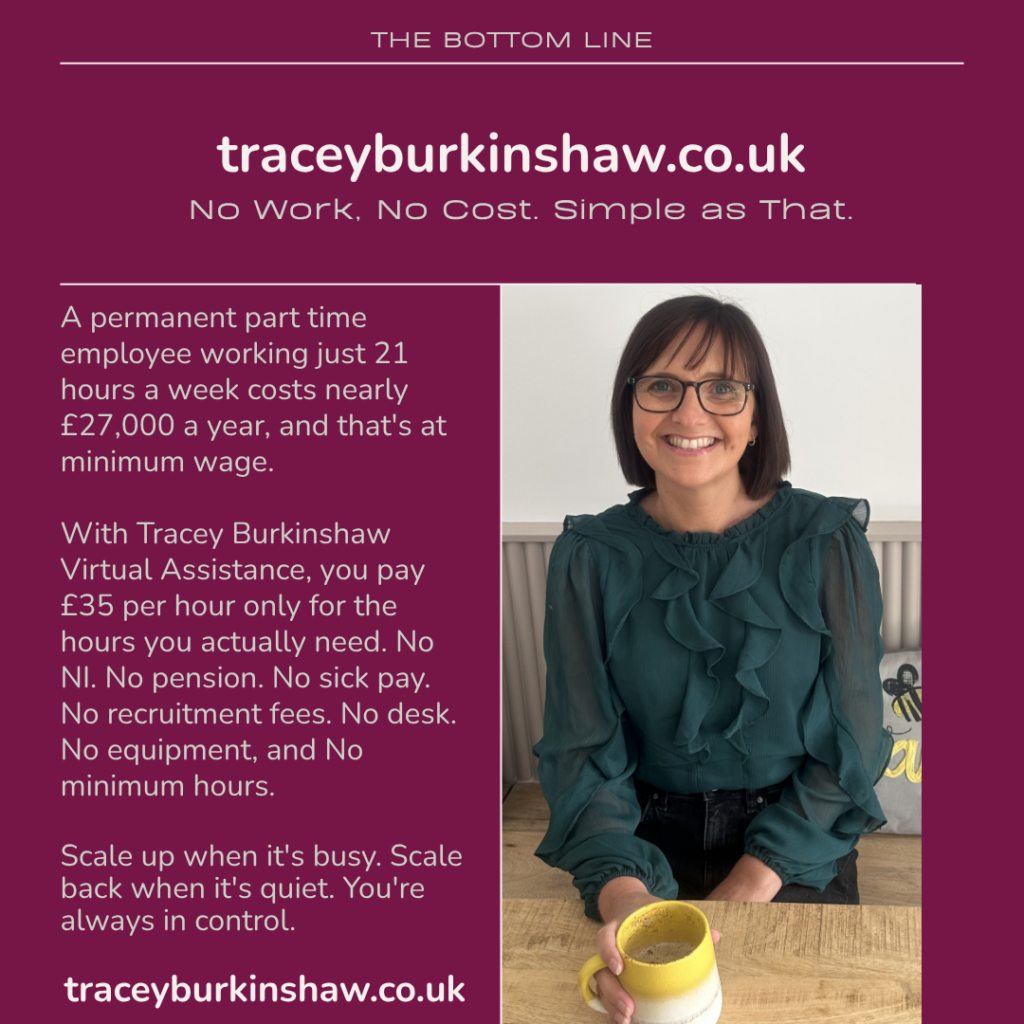
For most small business owners, the first thought is a part time employee. Maybe 21 hours a week, minimum wage, nothing extravagant. On paper that looks like the affordable option.
I did the research, and the true cost might surprise you.
The real cost of a part time employee
Let’s take that part time employee working 21 hours a week at the current minimum wage of £12.71 an hour. The salary comes to £13,880 a year. Sounds manageable, doesn’t it?
But the salary is only where the costs begin. Here’s what the full picture looks like:
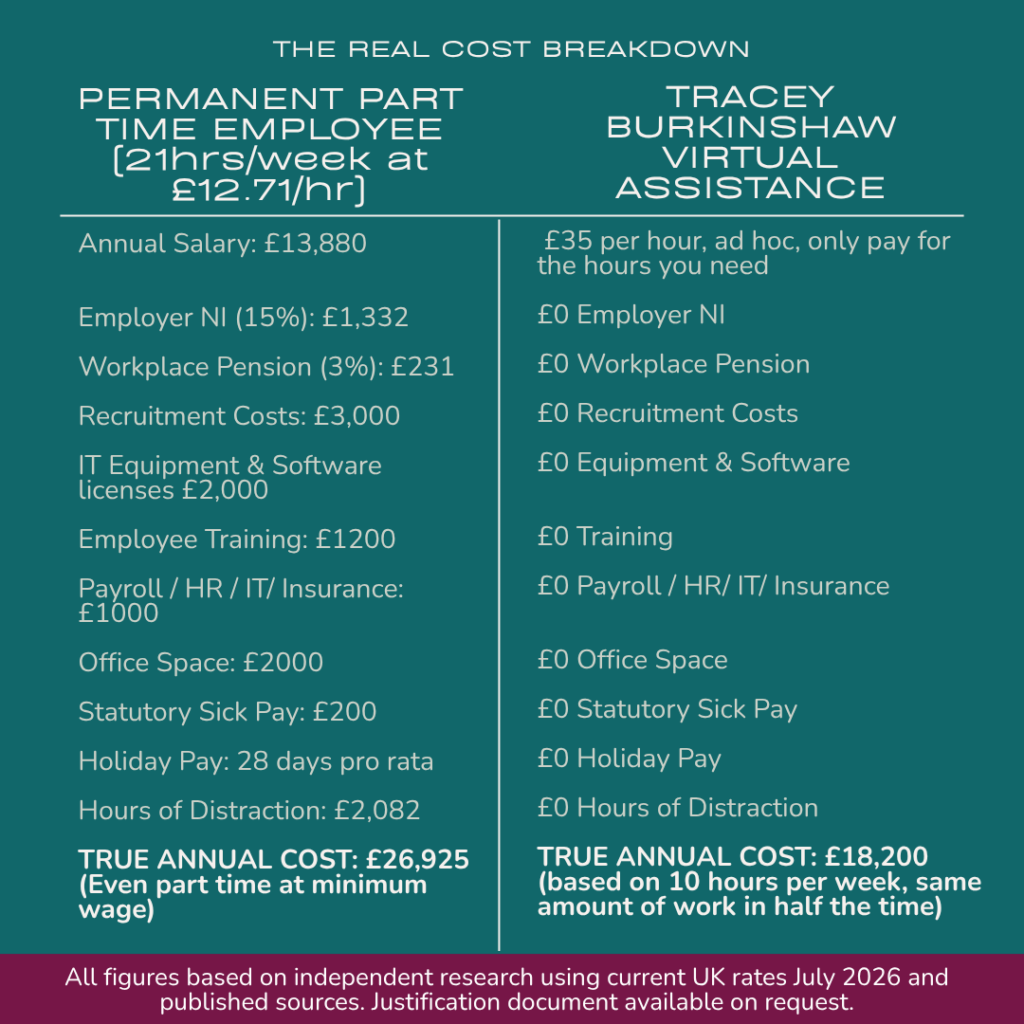
Nearly £27,000 a year. For a part time role. At minimum wage.
And that’s before you factor in holiday pay, which adds 28 days pro rata of paid time when the work still needs doing, or the time and money you’ll spend with recruitment agents, interviewing, onboarding and managing.
A quick word on the “hours of distraction” line. Research consistently shows that employees lose a chunk of every working day to interruptions, meetings and general workplace noise. It’s nobody’s fault, it’s just how employment works. But you’re paying for those hours all the same.
All of these figures come from independent research using current UK rates as of July 2026, and I’m happy to share the full justification document with sources if you’d like to see it. Just ask.
With a Virtual Assistant, the model is completely different. You pay for the work, and nothing else.
My rate is £35 per hour, worked on an ad hoc basis. If you’d like to guarantee my time each month, you can book a set number of hours in advance at the same rate. Same cost, just reserved for you.
If you worked with me for 10 hours a week, every week of the year, that would come to £18,200. And here’s the part that matters: an experienced VA working focused, uninterrupted hours will typically get through the same amount of work in around half the time. No commute, no meetings about meetings, no office chatter. Just the work, done.
So you’re not comparing 21 hours with 10 hours. You’re comparing the same output, at £26,925 versus £18,200.
No work, no cost. Simple as that.
The bit I love most about this model isn’t even the headline saving. It’s the flexibility.
When you employ someone, you pay them whether the work is there or not. Quiet month? You’re still covering the full salary, the NI, the pension. Busy month? You’re asking for overtime or watching things slip.
With a VA, you can scale up when it’s busy and scale back when it’s quiet. Working ad hoc, there are no minimum hours and no ongoing commitment. You’re always in control.
When hiring is still the right call.
I want to be fair here, because I’ve been an employee for most of my working life and there are absolutely times when hiring is the right call. If you need someone physically present, someone embedded in your team full time, or a role that will grow into something bigger, an employee may well be the better fit.
But if what you actually need is reliable, high standard support with the admin, the inbox, the diary, the spreadsheets and the tasks that keep getting pushed to tomorrow, it’s worth knowing all your options before you commit to a payroll.
Ready to run your own numbers?
Hourly isn’t the only way to work with me. If you’ve got one specific thing that’s been nagging at you, my Quick Wins sort a single small job for a flat fee. And for something larger, a bigger project or a proper piece of work, my set price packages give you a fixed cost from the start so you know exactly what you’re paying. Both are one off, with no ongoing commitment.
If you’ve been putting off getting support because you assumed it meant the cost and commitment of hiring, I’d love to show you the alternative. Drop me an email and tell me what’s eating your time, and we’ll work out what your version of the maths looks like.