
Grab a cuppa, because I want to talk about that list in your head.
The website page you keep meaning to update. The invoices you need to chase. The new idea you’re excited about, all sitting next to the admin that always seems to be waiting. None of it is written down in one place, so all of it follows you around: in the shower, on the school run, at 2am.
If that sounds familiar, you’re not disorganised. You’re just carrying too much in your head, and that’s one of the most common reasons I see small businesses get stuck.
What is a brain dump?
A brain dump is simply writing down everything that’s on your mind, all in one place, without sorting it first. For a small business owner, that means every task, idea, worry and unfinished job. Once it’s out of your head and onto the page, you can see what really matters, what’s stuck and what you could hand over.
Overwhelmed by your to do list? Here’s why it keeps you stuck
When everything lives in your head, every task feels equally urgent. Small jobs and big projects blur together, so it’s hard to know where to start, and easy to start nothing at all.
You also can’t see the pattern. Is that task stuck because you don’t have time, because you don’t know how, or because you’ve decided only you can do it? Until it’s written down, you can’t tell, and you can’t fix what you can’t see.
The answer isn’t a fancier app or a longer list. It’s a proper brain dump: getting everything out, then looking at it honestly.
How to do a brain dump for your business in 4 steps
- Get it all out. Write down every task, idea and unfinished job, however big or small. A few prompts help: What keeps moving to next week? What admin keeps piling up? What have you started but not finished? What could you hand over, but haven’t?
- Spot what’s stopping each one. Next to each item, note what’s in the way: not enough time, not knowing how, too many priorities, or feeling that only you can do it. If you think only you can, write down why.
- Ask what would help. A simpler process, clearer instructions, a better tool, or someone to help. If you don’t know, write “don’t know”. That’s useful too.
- Choose one small next step. Pick the item that would make the biggest difference if it moved. Then decide the smallest useful step, and when you’ll take it.
That’s it. You don’t have to solve everything at once. You just need to see it all clearly enough to move one thing forward.
What to do with your brain dump next
Once it’s all on paper, you’ll probably notice patterns. Lots of tasks that take too long. Several you don’t know how to do. A few you’ve been holding onto because it feels quicker to do them yourself.
If you’d like to go further, my To Do List Tracker takes your brain dump answers and suggests a route for every task: do it, break it down, simplify it, delegate it or ditch it. It challenges anything you think only you can do, shows you what keeps getting in the way, and helps you prioritise your tasks and choose your top five. It works in Excel or Google Sheets.
And if you’d rather not do the sorting yourself, that’s what I’m here for. Send me your brain dump answers and I’ll put them into the tracker, spot the patterns and create a practical plan for what to tackle first.
Brain dump questions small business owners ask
How do I prioritise my to do list when everything feels urgent? Start with a brain dump so you can see everything at once. Then pick the one task that would make the biggest difference if it moved, and break it into the smallest useful next step.
How long does a brain dump take? About half an hour for most small business owners. Set a timer and keep writing until nothing else comes to mind.
Should I do a brain dump on paper or on screen? Whichever you’ll actually do. Paper feels slower and more thoughtful; on screen is quicker to sort afterwards. My free workbook works both ways.
How often should I do a brain dump? There’s no rule. Do one whenever your head feels full, or at natural turning points: before a busy season, after a break, or when you’re starting something new. In between, a quick weekly look at your list keeps it from building up again.
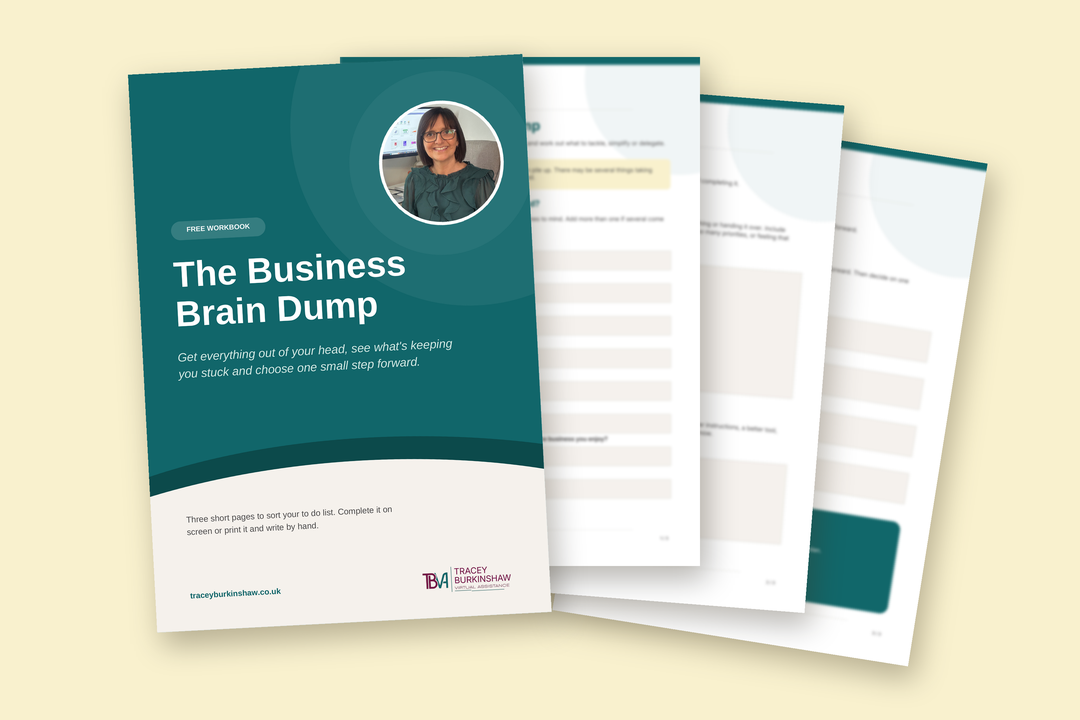
Get your free Business Brain Dump workbook
I’ve turned these four steps into a free short workbook, so you don’t have to start from a blank page. Fill it in on screen or print it out and write by hand, whatever suits you.
Put the kettle on, give yourself half an hour undisturbed, and get it all out of your head. And once it’s on paper, you’ll know exactly what’s next: one small step, then the one after that. That’s how stuck turns into sorted.