The best solution isn’t always human or AI.
Sometimes it’s both.
It feels as though everywhere you look at the moment, somebody is telling you about another thing you can automate.
AI can write your emails, create your content, answer customer questions, analyse information, organise your diary, summarise meetings and take care of repetitive admin.
And there’s understandably a lot of conversation about what AI might replace. Will it take people’s jobs? Will businesses need fewer people? What happens to human skills as technology becomes capable of doing more?
I don’t think we should ignore those questions. But I also don’t think the future has to be a choice between people or technology.
Technology can save us enormous amounts of time and help small businesses do things that might previously have required far more people, money or hours in the day.
But just because you can automate something, that doesn’t mean you should.
In the age of AI, human connection matters more than ever
I’m a huge believer in using technology to make work easier.
I’m also a huge believer in people.
And I really don’t think those two things need to be in competition.
Especially in a small business.
Because in a small business, the person behind it is often part of the reason somebody chooses to buy from you in the first place.
They choose the photographer because they love their style. The accountant because they trust them. The consultant because they value their judgement. The artist because they connect with their work. The VA because they want that person supporting their business.
People are often part of what makes a small business worth choosing.
At the same time, small businesses have limited time, limited budgets and often one person trying to do far too much. We’d be crazy not to harness brilliant technology that can help us do more.
And that’s why I don’t see this as a choice between AI or humans.
The opportunity is to use technology to give us more time and capacity, without automating away the very things that make our businesses human.
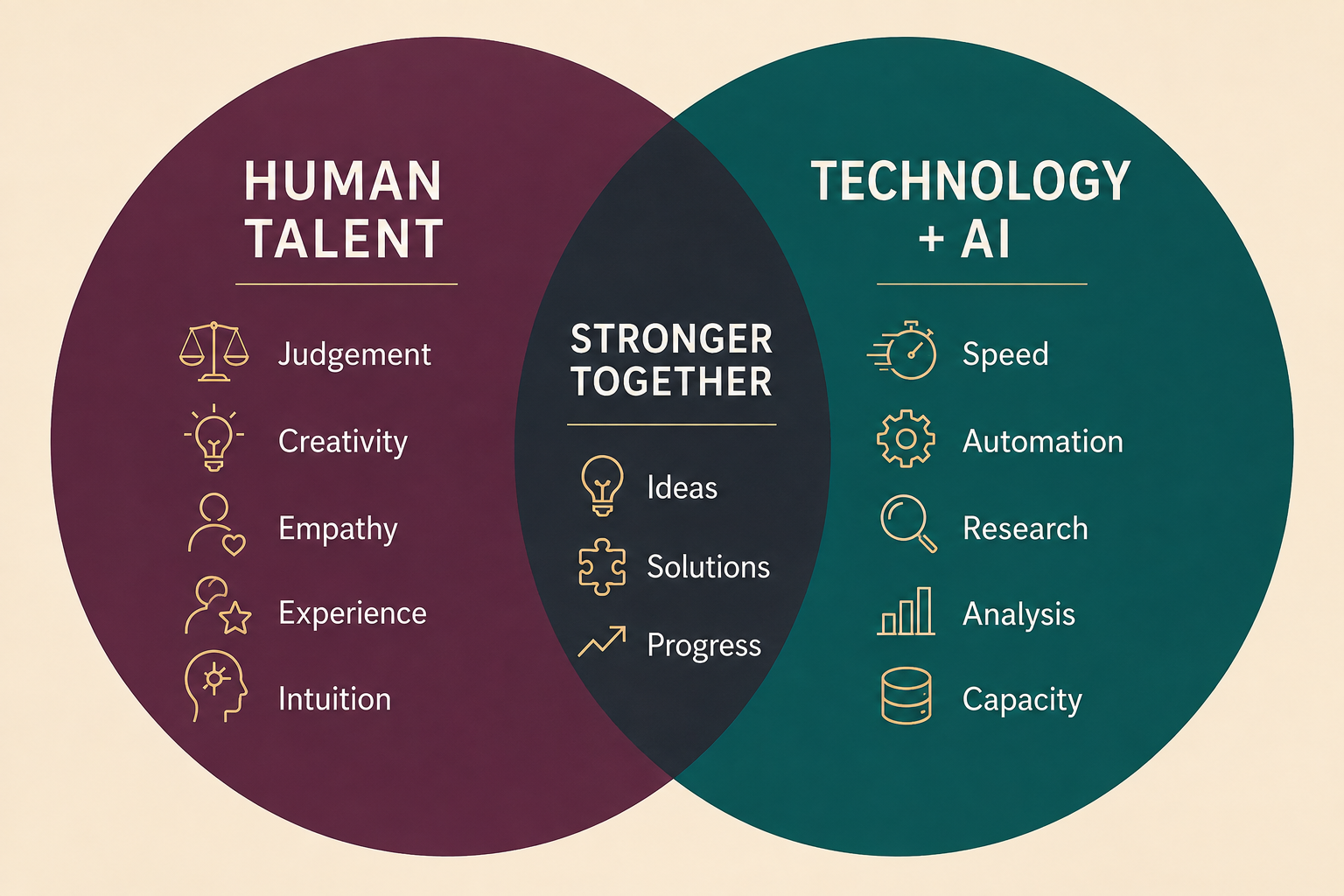
Our experience.
Our judgement.
Our creativity.
Our curiosity.
Our empathy.
Our personalities.
Our ability to read the room, understand the context and realise when something technically correct just doesn’t feel right.
And perhaps most importantly, our ability to connect with another person.
These are things technology shouldn’t replace, they’re valuable human talents in their own right.
A brilliant conversation can change someone’s thinking. An experienced person can spot the things technology might miss. Creativity can take us somewhere completely unexpected. Empathy can turn a difficult customer experience into a relationship built on trust.
There is enormous value in people being good at what they do.
AI doesn’t have to diminish that.
Used well, it can give people more time and space to be brilliant.
Start with the problem, not the technology
This follows on from something I wrote about recently when looking at how to delegate in a small business: start with the problem you actually want to solve.
I think exactly the same principle applies to automation.
It’s incredibly easy to discover a clever new piece of technology and immediately start looking around your business for somewhere to use it.
I’d turn that around.
What is taking too much time?
What are you doing repeatedly?
Where are mistakes happening?
What gets forgotten?
What are you constantly copying from one place to another?
What is stopping you or somebody in your team from spending more time on the work you’re actually good at?
Find the problem first. Then decide whether technology is the right solution.
Sometimes it will be.
Sometimes it won’t.
What is worth automating?
The obvious place to look is repetitive work.
If you’re regularly copying the same information between systems, sending the same reminders, organising the same types of data or carrying out predictable steps over and over again, there’s a good chance technology could help.
But automation doesn’t necessarily have to mean handing an entire job over to a computer.
It could be as simple as a form automatically putting information in the right place.
A reminder being sent without somebody remembering to send it.
AI summarising a long document before a person reviews it.
A system preparing information ready for somebody to make a decision.
Or AI helping create a first draft that a human then improves.
Things that might lend themselves to automation include:
- Appointment reminders
- Routine follow ups
- Repetitive data processing
- Regular reports or notifications
- First drafts of routine content
The aim isn’t to remove people from the process.
It’s to remove work that doesn’t need a person’s time, talent or attention.
AI can make more room for human talent
This is the bit I think sometimes gets lost in conversations about AI.
We talk so much about what AI might replace that we forget to talk about what it might make possible.
Imagine somebody brilliant at building relationships with customers spending several hours every week copying the same information between systems.
A creative business owner losing a day every month pulling together the same information for a regular report.
An experienced administrator reformatting the same documents every month and spending hours manually checking reports for changes that need attention.
Different roles, but the same problem: valuable human time being swallowed up by repetitive work. That isn’t the best use of their time or skills.
This kind of repetitive work led me to build one of my own digital tools. A report comparison tool that highlights the changes between two reports, but the person still reviews those changes and decides what needs attention. The technology speeds up the repetitive part; the human brings the experience and judgement.
If technology can make some of the repetitive parts quicker or easier, the person hasn’t become less valuable.
We’ve created more room for the valuable bit.
More time to think.
More time to create.
More time to solve problems.
More time to speak to customers.
More time to develop ideas.
More time to do the things that person is uniquely good at.
That’s the kind of automation I find exciting.
Using AI to support, not replace, creativity
Technology can support the creative process too. AI can help with research, organise a muddle of thoughts, explore different approaches or help you get past the terrifying blank page.
But support isn’t the same as replacement.
There’s a big difference between asking AI to produce something and publishing whatever comes back, and using AI to help you create something better. The human is still bringing something important to that process.
You still bring your experience.
Your opinion.
Your judgement.
Your knowledge of your customers.
Your sense of humour.
Your stories.
Your taste.
Your ability to say:
“No. That’s not quite right.”
AI might help you explore an idea, but you decide whether it’s a good one. It might help you find the words, but you decide whether they sound like you. It might help you get somewhere faster, but your judgement decides where you’re actually going.
AI can support the creative process without replacing the human creativity behind it. Used well, it can give us more room to create.
Some things absolutely deserve to stay human
There are situations where efficiency shouldn’t be the only thing we’re measuring.
Human involvement matters most when:
- A customer is upset and needs to feel heard
- Someone needs reassurance
- A decision needs context or judgement
- The circumstances are unusual or don’t fit neatly into the normal process
- A conversation requires sensitivity
These are the moments where judgement, empathy and context really matter.
Technology can still help around the edges. It might find information, prepare notes, organise history or take care of the admin afterwards.
But sometimes a person simply needs another person.
And that doesn’t only apply when there’s a problem.
We choose to work with people because we like them. We remember the person who made us laugh, understood what we were trying to achieve or came up with an idea we would never have thought of ourselves.
Relationships create trust. Conversations spark ideas. Different experiences and perspectives make our work better.
Human connection isn’t an inefficiency we need to automate out of a business. It can be one of the things that makes a business worth choosing.
And I think businesses that understand that distinction will become increasingly valuable as automated interactions become more common.
There are practical considerations too.
Not every piece of information should be dropped into an AI tool. If you’re dealing with personal, confidential or sensitive information, you need to think about privacy, security and data protection, including your responsibilities under GDPR.
Sometimes human involvement isn’t simply about providing a better experience. It’s about making sure information is handled appropriately, decisions have proper oversight and somebody takes responsibility for the outcome.
Human and AI can be better together
So rather than asking:
“Could AI do this?”
I’d rather ask:
“What’s the best way to get this done?”
Perhaps technology can do the whole thing.
Perhaps a human should.
But very often, I suspect the best answer sits somewhere in the middle.
Let AI do the research, then let a person decide what matters.
Let technology organise the information, then let experience interpret it.
Automate the reminder, then have the real conversation.
Use AI to create the first draft, then add the personality, opinion and judgement that make it yours.
Let technology handle the predictable parts and people handle the exceptions.
It isn’t AI or human. It can be a fabulous mix of both.
Technology should give people more room to be brilliant
AI and automation are moving incredibly quickly, and none of us knows exactly what our businesses will look like a few years from now.
But I don’t think the goal should be to automate as much as we possibly can.
The goal should be to use technology where it genuinely makes things better.
Remove repetitive work that doesn’t need human attention.
Use AI to support our thinking and creativity.
And celebrate the places where human judgement, talent and connection make the difference.
Use technology for what technology does brilliantly. Let people shine at what people do brilliantly. And combine the two when that’s better still.
Because just because you can automate something doesn’t mean you should.
Sometimes technology is the answer.
Sometimes a person is.
And sometimes the really clever bit is knowing how to use both.
Ready to look at your own business?
If this has got you thinking about the way you work, where your time goes and what could be made simpler, there are a few ways I can help.
Not sure what could work better?
My Business Efficiency Review, gives you a fresh pair of eyes on the way you’re working, helping to spot where things could be simplified, streamlined or done differently.
Got a specific problem you just want sorted?
Take a look at my Quick Wins for practical, one off help with the things that are slowing you down.
Or keep reading:
How to Delegate in Your Small Business Without Creating More Work for Yourself